Wednesday, May 14, 2008

Do-san: Front Kick Drill

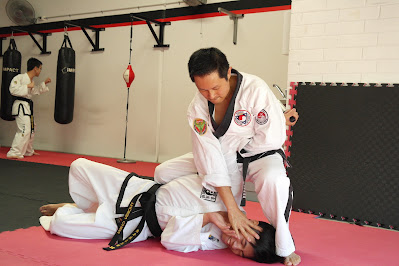
This drill is done in an open stance to get feedback on how the front kick lands on a human target. The striking area is on the side of the oblique abdominal muscles above the belt line.

Problems yesterday encountered:
1. Kicking too hard
2. Kicking too high
3. Kicking with sub-optimal foot position
4. Guarding hands not providing coverage

THe kick is done as a way to get feedback from the opponent, having a balanced power output and not kicking the opponent too hard means you can kick him many more times before he gets fedup of the entire exercise. Furthermore, kicking light to moderate allows you to calibrate distance and accuracy to 'group' the kicks onto the target area.

Much of the problem last night stemmed from just wanting to kick. Many people ... beginners, just focus on the primary kicking motion. Unfortunately, with the upward front kicking leg snap, this means that the kick seems to be travelling upward. So instead of kicking the side of the abs, you end up kicking your opponent's chest. With this trajectory, little penetration or effect will occur. This drill is about driving the kick horizontal and punching or punctuating the upward motion with a forward thrust. The strike is perpendicular to the body - not something to give your opponent a breast lift.

Colin

Wednesday, May 7, 2008

Doh-san: Front Kick

Last night, my newly promoted orange belt was working on her front kick. The front kick is aimed towards an opponent standing in front of you, as opposed to an opponent grabbing onto you. This means that the kicking foot is flexed forward in order to strike the body of a standing opponent. Notice how beginners would figure the kicking motion out quickly - meaning to get the right balance and power that the kick goes out smoothly and comes back without too much wobbling. However, most beginners, especially those working on 'traditional' technique forget to 1) engage hip movement to generate power, and 2) have great difficulty in keeping the COG low. Hips have got to be rotated in order that the kicking motion is driven by body mass without hip movement, you're only kicking with the leg, rather than the whole body. Keeping the COG low and not stand up whilst kicking allows you to control the supporting leg and drive yourself forward as you remain connected with the ground.

Saturday, May 3, 2008

Re-acquainting myself with Kwang-gae

It's good to see my old pal Jon Alster, 13-14 years younger on A-Kato's official forms DVD performing Kwang-gae. I've been remiss and haven't practiced a lot of my upper belt Taekwondo forms, choosing to focus on the Tang Soo Do ones instead. In the last week, I've done the form maybe half a dozen times or more a day. After not doing the form for more than a year or so, it took me about two days to get reacquainted with it.


BTW - please check out GM Keith Yate's new book Complete Guide to American Karate and Tae Kwon Do. I have ordered myself a copy, and I'm really looking forward to it.

It's my turn to disappoint the class. I've cancelled tomorrow's training because I'm going on a survival course!

Have fun kids!

Wednesday, April 30, 2008

Winter Training

Out of my six regular students, 4 cancelled out on me last night and two didn't show. Yet it was a great workout session. I went through all patterns from white to black - Chon-ji, Dan-gun, Do-san, Won-hyo, Yul-guk, Choong-gun, Toi-gye, Hwa-rang, and Chung-mu. I also went through Basai and Tekki, and applications from Basai and Tekki. All this in under and hour with time to go home and watch TV! Fantastic!

Friday, April 25, 2008

Dan-gun: Middle Block Drill

Middle Block Drill

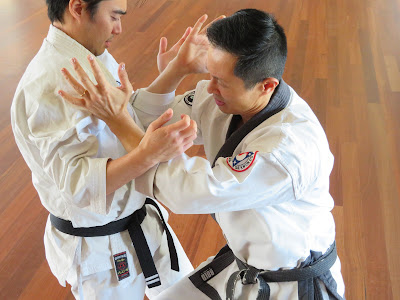
I've been invited to do an interview for the Australasian Taekwondo Magazine, and have been trying to organise some photos of myself and my students. It's really difficult to capture good shots. This is one taken during a drill featuring a middle block done as a defence against a front lunge punch - a requirement for yellow belts in my system.

Jacqui's left hand in an open palm position was to show her that she could use her back hand to deflect other strikes, and is a transition before she traps the extended strike and 'blocks' her opponent's nose with her right fist.

Tuesday, April 22, 2008

Power Generation in Roundhouse Kick Videos

Long range roundhouse kick


Short range roundhouse kick


Please check out previous post on the topic. Hope you enjoy it.

Do you have links to your roundhouse kicks you'd like to feature below?

Links

Mawashi Geri from Mat's Way

Tuesday, April 15, 2008

Hwa-Rang: Roundhouse Kicks, the Long and Short of

Roundhouse Kick: Muay Thai and Taekwondo

I want to talk about power generation for the taekwondo roundhouse kick. Specifically the difference between long range and short range differences in the kicks used in 'traditional' taekwondo.

The short range, or what I'd refer to as a 'traditional' roundhouse kick (which is part of the basic kicking techniques in our style) is the kick probably sourced directly from Karate. This is the roundhouse kick that hits as close as you could grab the opponent. The roundhouse kick travels horizontal and hits perpendicular to the bearing of the opponent encouraging the stylist to strike with the ball of the foot rather than the instep. The body of the practitioner is tilted sideways and there is triangulation occuring between the body, kicking and support leg to strike at this distance.

The long range version of the roundhouse, which I've 'imported' in from another style, but is really an early version of the roundhouse kick ultimately used by TKD stylists today, requires a full extension of the body, encouraging the user to strike with the instep of the foot rather than the ball. It still hits perpendicular to the bearing of the opponent. (Variations of this roundhouse kick include hitting with the ball of the foot and can hit the opponent with the same angle of entry as a side kick.)

The short and long of power generation ...

The short range roundhouse kick strikes a target at short range. It requires the user to bring the knee up, and kick out whilst contracting the body (not expanding the body). This means that, for all things being equal, the contraction of the abdominal muscles (the obliques in particular), lats to some part and hip flexors are the engine of the kick. Stability for the kick is provided by the body tilt which creates inertia in order that the faster kick is balanced by the larger mass of the body.

The long range kick however is done with the body at full extension. There is no triangulation set up to provide for contraction of core muscles or contraction of the body. This kick is done using a swinging motion and a pivoting around the support leg. The engine driving this kick (assuming that this is from the back leg), are the calf muscles pushing off the ground, the back and core abdominal muscles torquing the body, gluts of the support leg, and then the hip as the leg is swung forward. Muscles of the body are tensed and locked at impact in order to support the kick when it strikes.

The reason why I made sure to distinguish between the two is the position of the trunk of the body affects the power of the kick and (for the long range version) the calibration to land the kick properly. It is not sufficient to power through and hope the kick lands or lands hard on a bag. You need to kick hard but you need to have sufficient control.

Experiment with variations in body position in relation to power generation and you might surprise yourself.